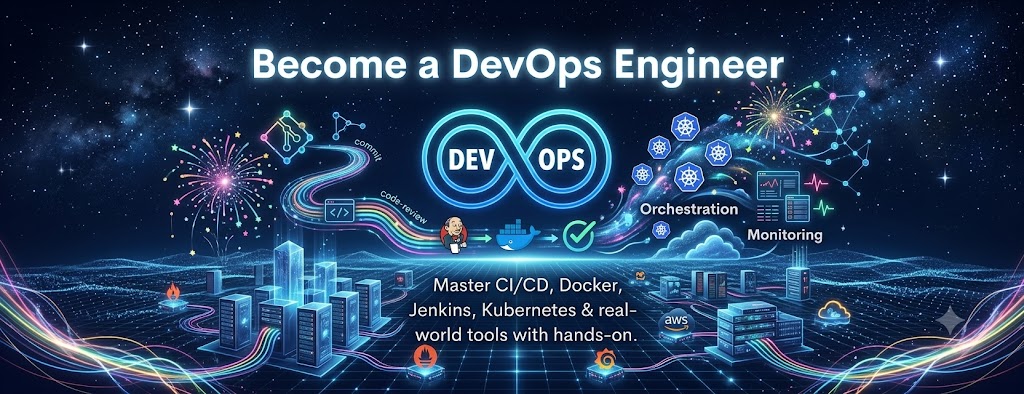
A modern DevOps Academy curriculum bridges the gap between software development and IT operations. A comprehensive, job-ready course structure is typically broken down into a 4-to-6-month roadmap.
Here is an industry-standard, production-grade DevOps training curriculum framework designed to take students from foundational IT skills to advanced cloud-native orchestration.
🏗️ Phase 1: Core Systems & Automation (Weeks 1–5)
Before touching complex cloud tools, students must master the environments where applications actually live and breathe.
-
Linux Administration & CLI: File permissions, process management (
top,ps), text stream processing (grep,sed,awk), and system monitoring. -
Networking Fundamentals: Understanding the OSI model, DNS, TCP/UDP, HTTP/HTTPS, ports, reverse proxies (Nginx), and load balancers.
-
Version Control (Git): Branching strategies (GitFlow vs. Trunk-Based Development), handling merge conflicts, pull requests, and multi-developer workflows.
-
Scripting & Automation: Writing automation logic in Bash and Python to handle routine system tasks (e.g., automating log backups or server health checks).
🚢 Phase 2: Containerization & Cloud Native (Weeks 6–10)
The foundation of modern application deployment relies entirely on packaging applications consistently so they work identically across all environments.
-
Docker Fundamentals: Writing efficient
Dockerfiles, managing image layers, multi-stage builds, networking, persistent storage volumes, and environment variables. -
Multi-Container Architecture: Using
Docker Composeto orchestrate multi-tier applications local to a developer’s machine. -
Cloud Infrastructure Basics (AWS/Azure/GCP): Getting comfortable with core services like virtual servers (EC2), cloud networks (VPC), identity management (IAM), and managed storage (S3).
🔀 Phase 3: CI/CD Pipelines & Continuous Delivery (Weeks 11–14)
Automating the software release engine so teams can ship code hundreds of times a day securely and reliably.
1.Code Commit & Trigger:The Source Step.
A developer pushes code to Git. Webhooks automatically catch the change and trigger an automated environment to spin up.
2.Continuous Integration (CI):Automated Testing & Building.
Using platforms like GitHub Actions or Jenkins, code is automatically compiled, linted, and run against unit tests. If any test fails, the pipeline halts immediately.
3.Artifact Packaging:Containerization.
Once tests pass, the code is compiled into a production-ready Docker image and pushed safely into a private container registry.
4.Continuous Deployment (CD):GitOps & Release.
Tools like ArgoCD or orchestration manifests deploy the fresh image straight to production with zero-downtime strategies (like Blue/Green or Canary deployments).
🌐 Phase 4: Scaling, Infrastructure as Code, & Observability (Weeks 15–20)
Managing production scale without ever configuring a server by hand, while ensuring complete visibility into system health.
-
Infrastructure as Code (IaC): Using Terraform to provision enterprise cloud components programmatically, preventing configuration drift across staging and production.
-
Kubernetes Orchestration: Deploying clusters at scale, managing Pods, Deployments, Services, Ingress control, and configuring Helm charts for package management.
-
Observability & Monitoring: Collecting metrics using Prometheus, visualizing cluster health through Grafana, and structuring application logs using the ELK Stack or Datadog.
-
DevSecOps Integration: Shifting security left by embedding automated vulnerability scanners (Trivy, SonarQube) directly into delivery pipelines.
💡 Academy Capstone Suggestion: Have your students deploy a multi-tier microservices web application on an AWS EKS (Kubernetes) cluster entirely provisioned through Terraform, with a fully automated GitHub Actions pipeline and active Grafana alerting dashboards. That single portfolio piece is what lands jobs.