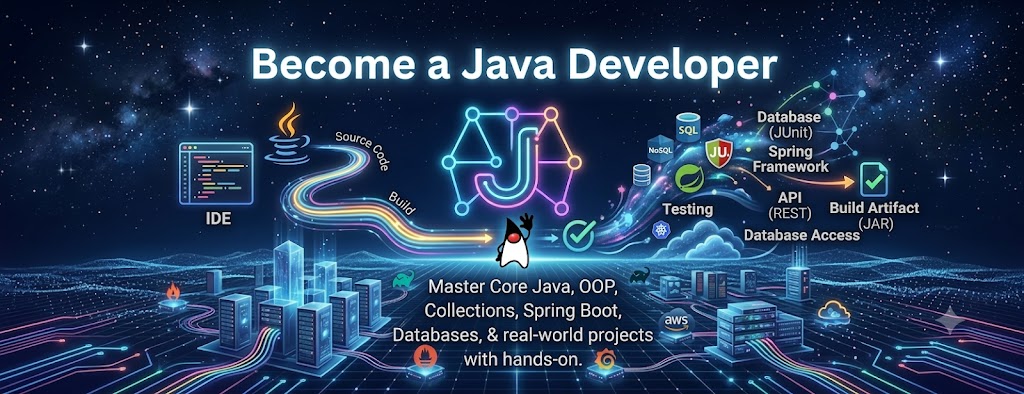
Java Training Academy Curriculum. It is structured into three progressive tiers—ranging from foundational programming to enterprise-grade cloud architecture—designed to take students from absolute beginners to job-ready software engineers.
Phase 1: Core Java Foundations (Months 1–2)
Focus: Mastering the syntax, logic, and object-oriented paradigms.
Module 1: Introduction & Environment Setup
The Java Ecosystem: Understanding the role of the JDK, JRE, and the Java Virtual Machine (JVM).
Cross-Platform Architecture: Exploring the “Write Once, Run Anywhere” (WORA) compilation process (Source Code $\rightarrow$ Bytecode $\rightarrow$ Machine Code).
Setup: Installing the JDK and setting up an Integrated Development Environment (IDE) like IntelliJ IDEA or Eclipse.
Module 2: Language Fundamentals
Data Types & Variables: Primitive vs. Reference data types, memory allocation, and Type Casting.
Operators: Arithmetic, relational, logical, and bitwise operators.
Control Flow Structures: * Conditional Statements (
if-else,switch-case).Looping Structures (
for,while,do-while, and enhanced for-loops).
Arrays: Single and multi-dimensional array manipulation, sorting, and searching.
Module 3: Object-Oriented Programming (OOP)
Classes and Objects: Defining state (fields) and behavior (methods), understanding constructor overloading, and the
thiskeyword.The 4 Pillars of OOP:
Encapsulation: Access modifiers (
private,public,protected, default) and Getters/Setters.Inheritance: Extending classes using
superand understanding code reusability.Polymorphism: Runtime (Method Overriding) vs. Compile-time (Method Overloading) polymorphism.
Abstraction: Abstract classes vs. Interfaces (including Java 8+ functional interfaces).
Module 4: Advanced Core Concepts
String Handling: Memory optimization via the String Pool,
StringBuilder, andStringBuffer.Exception Handling: The
Throwablehierarchy,try-catch-finallyblocks, multi-catch, and creating custom exceptions.Java Collections Framework: Data structures including
List(ArrayList, LinkedList),Set(HashSet, TreeSet), andMap(HashMap, TreeMap).Generics: Building type-safe, reusable components.
File I/O: Reading and writing files using Streams and the NIO package.
Phase 2: Advanced Java & Backend Essentials (Months 3–4)
Focus: Concurrent programming, database integration, and modern language features.
Module 5: Multithreading & Concurrency
Thread Lifecycle: Creating threads using the
Threadclass andRunnableinterface.Synchronization: Preventing data race conditions using
synchronizedblocks and explicit locks.Concurrency Utilities: Utilizing the Executor Framework, Thread Pools, and
CompletableFuturefor asynchronous execution.
Module 6: Modern Java Features
Java 8 & Beyond: Lambda Expressions, the Stream API for functional data processing,
Optionalclass to safely avoidNullPointerException, and Record types.
Module 7: Database Connectivity (JDBC) & Build Tools
SQL Basics: Writing relational queries, joins, and indexing (using MySQL or PostgreSQL).
JDBC: Establishing database connections, executing statements, preventing SQL injection using
PreparedStatement, and transaction management.Build Tools: Structuring enterprise projects using Maven or Gradle (
pom.xmldependencies, build life cycles).
Phase 3: Enterprise Web Development with Spring Boot (Months 5–6)
Focus: Building production-grade microservices and REST APIs.
Module 8: The Spring Ecosystem
Inversion of Control (IoC) & Dependency Injection (DI): De-coupling application architecture using Spring Beans.
Spring Boot Foundations: Starters, autoconfiguration, and application properties management.
Module 9: RESTful Web Services & Data Persistence
Spring Web MVC: Creating REST controllers, handling HTTP methods (
GET,POST,PUT,DELETE), and processing JSON requests.Spring Data JPA / Hibernate: Object-Relational Mapping (ORM), repository interfaces, automated CRUD operations, and custom query construction.
Module 10: Testing, Security & Deployment
Unit & Integration Testing: Writing automated tests using JUnit 5 and Mockito.
Spring Security: Implementing basic authentication, JWT (JSON Web Tokens), and role-based access control.
DevOps & Deployment: Containerizing the Java application using Docker and preparing it for cloud deployment.
🛠️ Practical Academy Highlights
To bridge theory and career placement, an academy syllabus should explicitly include:
Capstones: A Full-Stack web application (e.g., E-Commerce API, Banking Portal).
Design Patterns: Coverage of Singleton, Factory, DAO, and MVC patterns during Phase 2.
Interview Prep: Weekly mock interview sessions focusing on Java coding standards and competitive DSA (Data Structures & Algorithms) challenges.